Cooperation · OEM / ODM
OEM and ODM process for custom storage locks
Complete order fulfilment from idea to finished product — branding, packaging, molds and the production processes behind them.
Branding and individual packaging
Your brand has to appear in three places at once — the product, the key and the box the tenant actually opens.
Box design development
Printed boxes, blister cards and paper cards developed from your artwork or designed for you.
Product marking and barcoding
Laser logo, unit-level serial numbers and barcodes applied on the line.
Standard integration sizes
70 / 85 / 90 / 96 mm centre distances integrate with your existing door preparation.
Artwork and data files are confirmed before production. If your serial number file contains a duplicate or a gap in the sequence, we tell you before we cut metal.
Design and manufacture of molds
A new mold is the point where a project stops being a purchase and becomes a development programme. We treat it that way — scope, cost and ownership agreed before anything is cut.
Requirement and feasibility
Drawing or sample review. We confirm what is possible, what it costs and the minimum run.
Tooling quotation
Tooling cost quoted separately and transparently, so your unit price reflects production only.
CAD review and proof
3D or CAD drawing issued for your approval before the mold is made.
First Article Inspection
Dimensions, finish and fit confirmed against the approved drawing.
Production release
Full run starts only after first-article approval.
MOCK|必须修改:替换真实图片
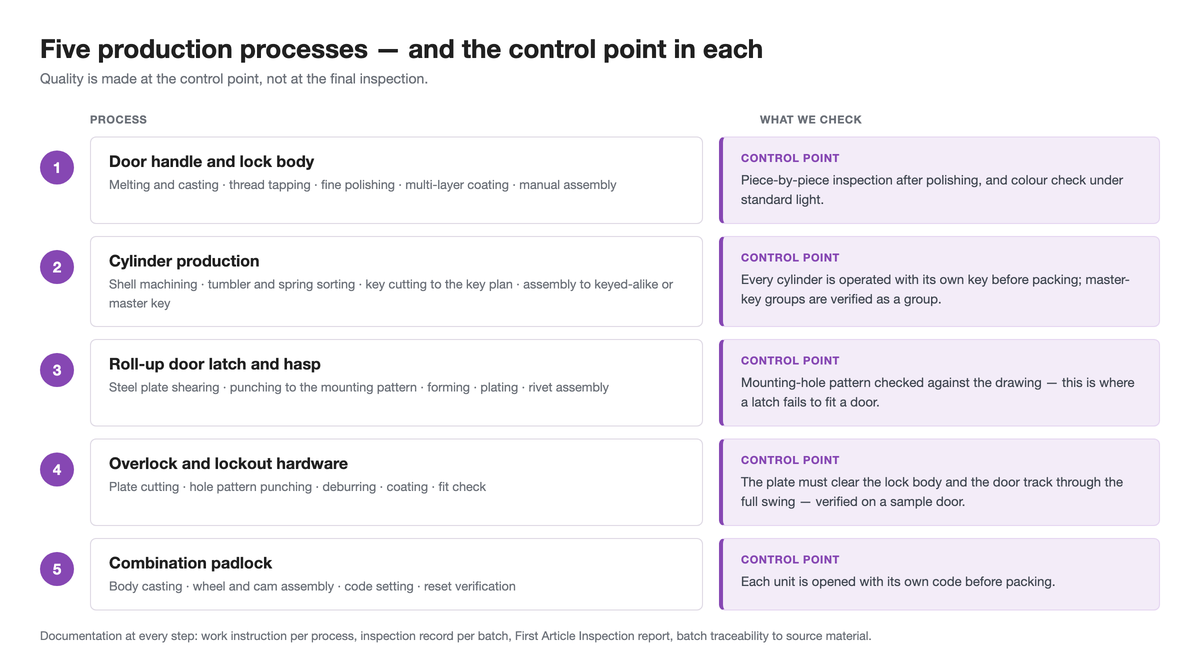
Five key production processes
Where the quality is actually made — and the control point that protects it.
1. Door handle and lock body production
- Melting and casting — primary ZAMAK / aluminium alloy
- Mechanical processing — automatic thread tapping
- Fine polishing — machine grinding plus hand finishing
- Multi-layer coating — reinforced electroplating
- Assembly and test — manual spring fitting and return test
- Branded packaging — your individual boxes
Control points: piece-by-piece inspection after polishing, and inspection under standard light for colour and surface consistency.
2. Cylinder production
- Brass or zinc shell machining and tumbler chamber cutting
- Tumbler and spring sorting to the keying schedule
- Key cutting and bitting to the key plan
- Assembly to keyed-alike, keyed-different or master-key configuration
- Function test — key turn and pick resistance check
Control point: every cylinder is operated with its own key before packing; master-key systems are verified against the group.
3. Roll-up door latch and hasp production
- Steel plate shearing and punching to the mounting pattern
- Forming and bending to profile
- Zinc plating or powder coating
- Bolt, spring and rivet assembly
- Travel and return test
Control point: mounting-hole pattern checked against the drawing — this is where a latch fails to fit a door.
4. Overlock and lockout hardware
- Plate cutting and hole pattern punching
- Edge finishing and deburring
- Coating to the agreed finish
- Fit check against the door and the unit lock
Control point: the plate must clear the lock body and the door track through the full swing — verified against a sample door.
5. Combination padlock production
- Body casting and dial or button manufacture
- Wheel and cam assembly
- Setting to the required code
- Reset-function verification
- Code check before packing
Control point: each unit is opened with its own code before packing; supplied serial number files are checked for duplicates before production.
Documentation at every step
- Work instruction per process
- Inspection record per batch
- First Article Inspection report
- Batch traceability to source material
- Pre-shipment photo and video approval
Technical regulations and OEM FAQ
Engineering questions buyers raise before releasing a custom order.
How is the finish quality controlled?
Finishing is checked visually under standard light, and each part is inspected by hand for micro-pores and plating defects before assembly. Salt-spray testing is used to verify corrosion resistance for the agreed finish.
Why is assembly done by hand?
An experienced operator feels spring tension and latch travel while assembling, which catches a stiff or mis-seated mechanism that a visual check would miss. Each unit is function-tested after assembly.
Do you use secondary zinc?
We use primary ZAMAK alloys. Secondary zinc reduces coating strength and durability, which shows up as finish failure in the field rather than at the factory gate.
How is spring reliability tested?
Springs are cycle-tested for metal fatigue before release to production, and assembled locks are cycled as part of durability testing. The applicable cycle count is recorded per test report.
What does the First Article Inspection include?
Dimensions, finish colour and fit are checked against the approved drawing or sample before the full run starts. If the first article fails, production does not start until it is corrected.
Who owns the tooling?
Tooling ownership and maintenance terms are agreed in writing before development starts, together with the tooling cost, which is quoted separately from the unit price.
Can you customise electronic access hardware?
Packaging and branding can be customised in the same way as the mechanical families. Changes to the electronic assembly itself — board, reader or firmware — are confirmed per project before anything is quoted, because they depend on the platform the lock is built on.
Send your drawing or sample
Tell us the model, the change, the quantity and the destination. We will confirm feasibility, tooling and MOQ before anything is committed.